

At last weekend’s Lagos Fashion Show, one of the most striking moments belonged to Awa Meite — the Malian-born brand renowned for its eco-conscious ethos and handcrafted excellence. But at the heart of this showcase was Kemi Dada, a key creative force advancing the label’s sustainability agenda across Nigeria.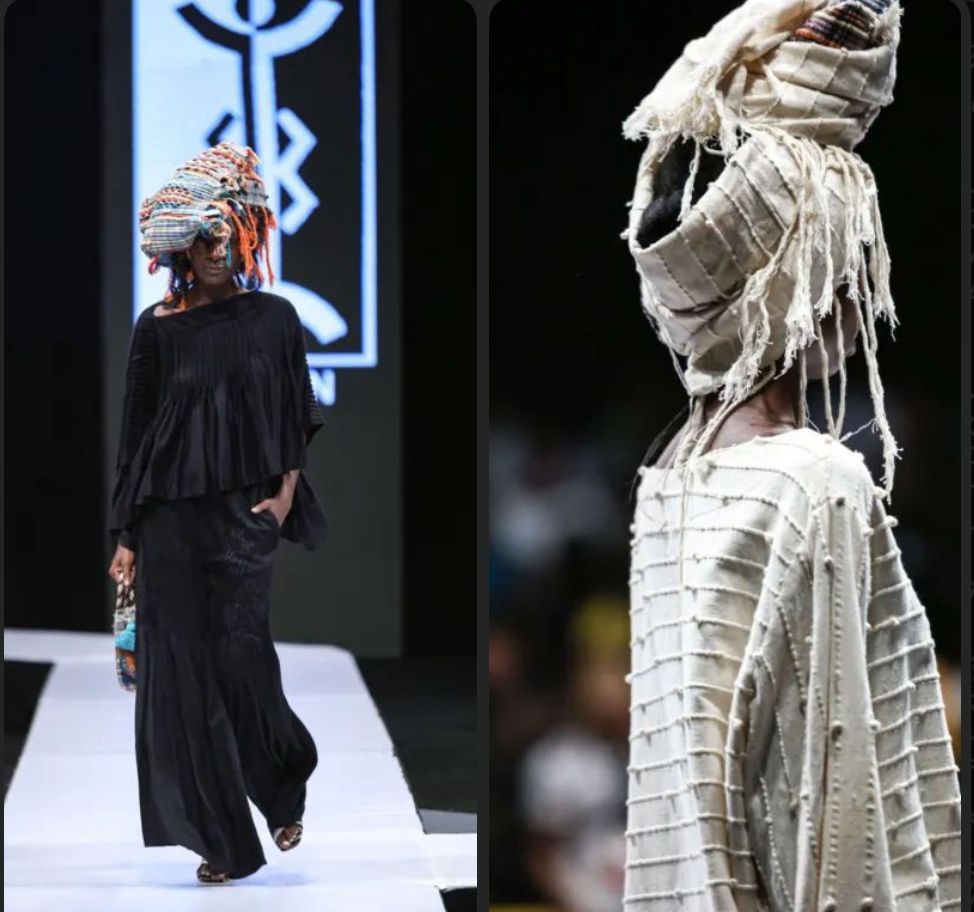

Founded by the multi-talented Awa Meite, the brand has always stood for more than fashion. Its philosophy champions local transformation, ethical production, and the belief that “Made in Africa” can and should compete on the global stage.
By weaving cultural heritage into contemporary design, Awa Meite not only challenges fashion’s homogenizing tendencies but also asserts diversity as strength, breaking stereotypes while carving space for equity.
Kemi Dada’s fingerprints were evident on the runway. One look in particular captured the essence of the collection: a loose,textured tunic made in different colours that spoke the language of restraint and quiet luxury. Subtle linear detailing and delicate embellishments gave the piece movement and depth, while frayed hems and sleeves reminded us of the human touch, elevating imperfections into art. This was not glossy, impersonal perfection; it was authenticity made visible.
The ensemble was crowned with a sculptural headpiece; a daring composition that fused traditional references with contemporary audacity. More than an accessory, it stood as a metaphor for Africa’s layered identities, past and future entwined in one confident statement.
In hand, some the models carried a multicolored tassel bag, playful yet grounded, balancing seriousness with joy and celebrating artisanal creativity.
This was fashion as manifesto. Dada’s interpretation of Awa Meite’s vision made clear that sustainability here is not a marketing slogan but a lived philosophy. Through local production, eco-conscious materials, and time-honored techniques, the designs expand the definition of what it means for fashion to be both global and proudly African.
Yet what made this showcase compelling was not just its beauty, but its challenge to the industry. At a time when fashion risks drowning in sameness, this collection reminded us of the power of narrative and cultural specificity. It asked: what happens when African designers take control of their own stories, their own aesthetics, their own futures?
The answer, in this case, was clear. On that runway, Kemi Dada proved that a dress can carry more than style. It can carry history, sustainability, and vision. It can be, unapologetically, a manifesto.