

The idea that clothes can carry a kind of music, notes you can’t hear but can watch is valid. These two looks move like musical instruments, one a drumline recalling ceremony and the other a trumpet, delightful for listening.
They do not mimic the past, they converse with it until something contemporary appears, something lucid and felt. This is the Afi Collection by Boriah Couture, released on November 2nd, 2022, under the Creative Director of Goodluck Jane Okwuchukwu.
Orange Song: Adirẹ̀ Kaftan with Fringe & Coral.

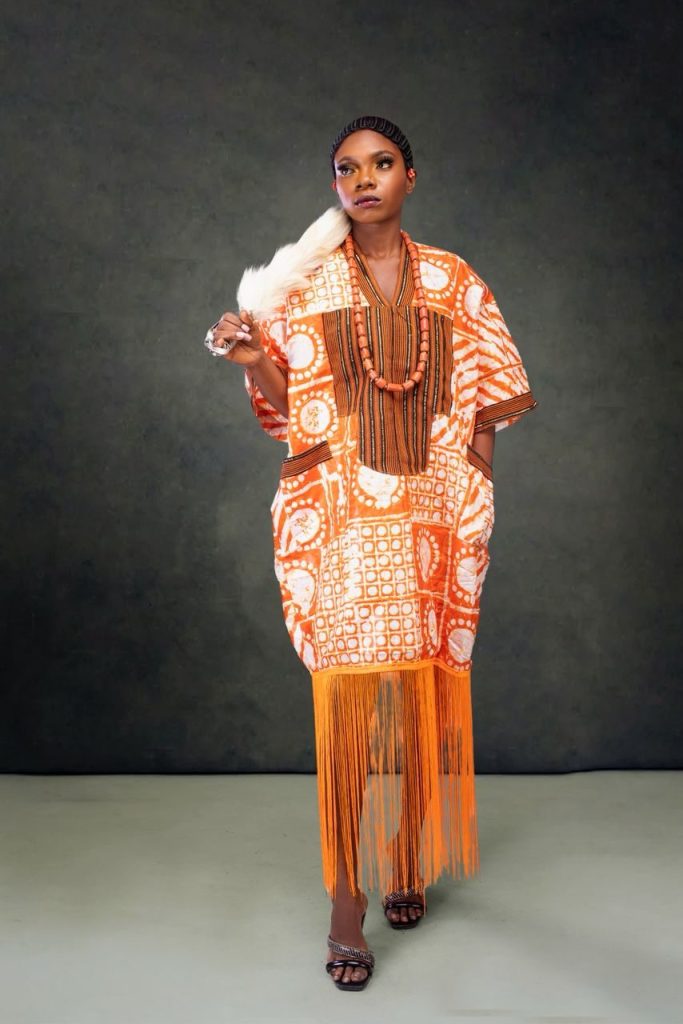
The first look advancing like a procession is a loose kaftan, cut from hand patterned adire fabric in sun bright orange, resisting white in circles, grids, and leaf silhouettes, falling into a waterfall of tangerine fringe that brushes from the kneel to the ankles.
At the chest, a panel of striped aso-oke interrupts the geometry, a vertical throat that steadies the print’s exuberance. Around the neck, coral ìlẹ̀kẹ̀, matte and warm, the weight that turns adornment into punctuation. In the hand, an irùkèrè horsetail, neither costume nor cliché, but a small choreography of authority.What the photograph can’t show, the garment suggests, sound; fringe has its own percussion, adire has a faint paper like rustle, coral beads click at each step.
The piece makes music for the ceremony. Yet it’s also practical with pockets hidden inside the print’s logic, sleeves cut to allow gesture, a hem whose swing keeps the kaftan from reading monastic.
The overall construction reveals respect. The adire blocks are aligned so circles meet circles, the aso-oke panel is inset rather than appliquéd, a more difficult choice that keeps the front flat.
Fringe is weighted just enough to hang true. The silhouette is generous without erasing the body; when she walks, negative space opens around the legs like a corridor.If there’s politics here, it’s the gentlest kind, heritage treated as current tense.
This is not museum dressing. This is a city garment Lagos, Accra, anywhere capable of blessing an ordinary afternoon.
Blue Trumpet: Bubble Peplum in Taffeta
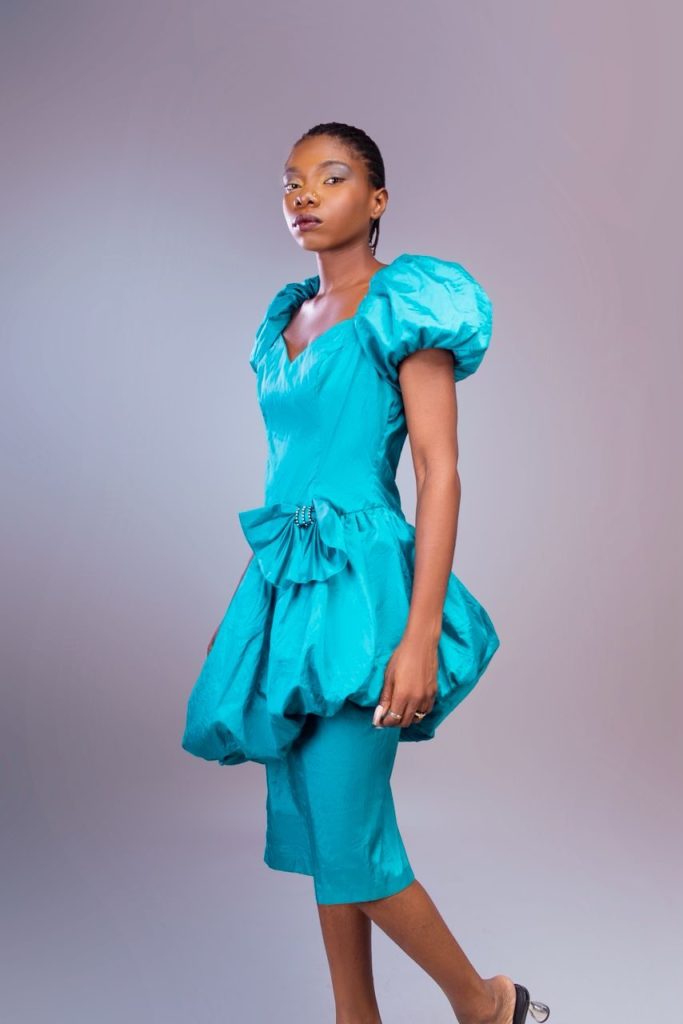
The second look is a celebration given structure. A teal taffeta dress, cut with a sweetheart dip and clouded sleeves, blooms at the waist into a bubble peplum, a memory of 1980s couture scaled to present sensibility before tapering into a pencil skirt that stops mid calf.
A small bow rosette with beadwork sits askew, like a wink. Where the kaftan holds space through volume, this dress sculpts it. Taffeta, that instrument of crisp light, is a deliberate choice, it records every fold like a notation.
The bubble is drafted with internal tucks and a hidden crin like air trapped on purpose, so the shape sits away from the hips rather than inflating them. Sleeves are full but not silly, they frame the clavicle and draw the eye to the face, which the makeup wisely leaves mostly luminous, not lacquered.
The silhouette resolves a problem many “statement” dresses mishandle; weight distribution. Volume lives at the shoulder and hip, while the skirt’s pencil line and bare lower leg restores verticality. She appears taller, not swallowed.
The dress moves best in quarter turns, light slips across the teal like fish under water.Read together, the looks make a proposition that fashion can be a site of kinship between ritual and play.
One garment remembers the square, the courtyard, the blessing; the other remembers the dance floor and the camera flash. Both are specific, Yorùbá codes in cloth and bead and fringe; global couture in cut and finish, yet neither requires translation to be admired.They also model a principle worth repeating, volume appearing as care.
In the kaftan, volume grants dignity; in the blue dress, it produces delight. The designer’s hand appears in the edits, the pockets that don’t bulge, darts that don’t shout, hems that meet the floor at right angles.
Nothing is lazy here, everything is chosen. Orange Song is for naming ceremonies, gallery openings, cultural councils and places where presence needs to be both grounded and generous.
The Blue Trumpet is for reception rooms, premieres, Sunday parties that become Monday stories.
Author: Chinazam Ikechi- Uko