

There is a particular pressure placed on emerging African brands right now: prove that you understand sensuality, but don’t let it look cheap. Prove that you can do romance, but don’t fall into cliché.
Prove that you can flatter the body, but don’t get accused of body exploitation. It’s a narrow, punishing lane. With the Flow Collection (released June 15th, 2023), Ranto Clothings under Bright Urhobo doesn’t just move within that lane, it widens it.

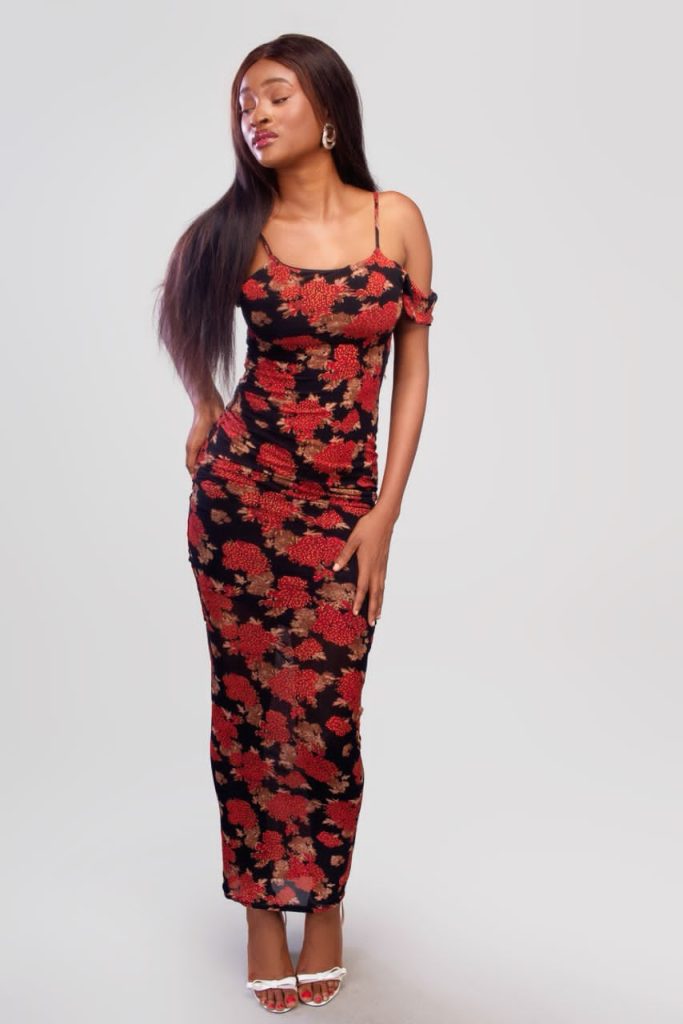
This dress is an argument for softness as a form of self-definition.
We’re looking at a long, fitted dress rendered in a clingy floral fabric. Slim straps. Shoulder exposure. A narrow, ankle-grazing length. It’s tempting to read it purely as “date-night.” But that would be shallow.
There’s more happening here. The silhouette hugs without squeezing. The dress follows the natural line of the body; bust, waist, hip, thigh and then continues downward in a clean vertical drop to the ankle.
No slit, no flare, no trumpet effect. The choice not to break the line is important. It gives calm. It gives self-possession. It says: this is my outline; you can observe it, but you’re not invited to rearrange it.
A lot of “bodycon” dresses in the mass market are designed like demands: shorter, tighter, shinier. This is different. The fit is body conscious, yes, but not desperate. It’s confident. You feel the wearer is in control of the reveal.
The fabric is what builds that confidence. We’re looking at a black base with floral motifs in deep red and warm gold/brown, distributed across the entire dress. The floral isn’t naïve or girlish. It feels like chrysanthemums or marigolds in bloom; full, layered, pulsing with texture.
The placement of those florals matters. They’re not arranged in symmetrical, polite clusters. They’re scattered in a way that creates visual movement along the body. Your eye moves diagonally, not straight down. That soft diagonality adds flow, which is likely one of the core ideas the collection is named for.
On a practical level, that print distribution also does gentle shaping work.
Dark base, dense florals across the curves: it visually smooths and balances. It’s doing some of the work women are often told to hand over to shapewear. The dress itself is doing that work.
And this is where you start to see Urhobo’s priorities. He’s not just thinking about the garment in isolation. He’s thinking about how a woman will feel in it, with a camera on her, with eyes on her. He is writing comfort and ease into a form traditionally associated with scrutiny.
One detail that feels both intimate and intelligent: the shoulder treatment. The dress features delicate spaghetti straps, but also what appears to be a relaxed drop of fabric at the upper arm, almost like the sleeve has slipped off on purpose and stayed there. It’s a tiny gesture, but it has emotional temperature. It says: softness is allowed here.
Vulnerability is allowed here. But it also hints at play, like the moment you pull your sleeve down just a little in a room you’re comfortable in.
In other words: it reads sensual, but it doesn’t read performative. That is very, very difficult to design.
Let’s talk about the textile itself. We’re almost certainly in stretch territory, a jersey or jersey-blend, possibly with elastane. The fabric clings, but it doesn’t look suffocated. It drapes close to the skin but still falls vertically near the calf. That vertical fall tells us the textile has some weight to it. Lightweight jersey tends to bunch. This doesn’t bunch. It lies.
That weight is crucial: it gives the dress maturity. Lightweight bodycon reads as teenage clubwear because it fights the body and curls up. This one rests. It settles. It behaves like a grown woman’s dress.
The finish of the textile matters, too. We’re not seeing aggressive shine. No liquid gloss, no wet-look polyester. This is a soft matte, which instantly lifts it into elegance. A matte surface lets the print hold attention without competing with light reflection. You notice the color relationships: the deep red against the near-black, the warmth of the brown/gold, the almost lacquered tone of the lips echoing those reds. You see the intention.
Fast fashion has spent the last decade telling women that empowerment looks like aggression, cutouts, corsetry, enormous slits, body-as-advertisement. The alternative, from the luxury houses, has often been the opposite extreme: oversized silhouettes meant to signal intellect, as though volume automatically equals seriousness.
What’s happening here in Ranto Clothings’ Flow Collection is something more honest. The design says: you have a body, you live in it, you are allowed to enjoy how fabric feels on it. Full stop. It is neither apologizing for curves nor weaponizing them.
The future of womenswear, if it’s going to have integrity, must prioritize emotional wearability: clothes that let you feel attractive without performing trauma level compression, and let you feel feminine without performing fragility. This dress sits exactly in that space.
This is also, very smartly, a commercial piece. It’s a one step outfit: no bra complication (thanks to the straps and fitted bust), no complicated closures, no need for shapewear unless you personally want it. You slip in, you’re done. For an emerging brand like Ranto Clothings, this is how you build loyalty. You don’t only offer fantasy gowns for events women attend twice a year. You offer a dress they can wear on dates, birthdays, dinners, trips, and crucially in photographs that will live on their social feeds.
And social performance is currency. A piece like this doesn’t just sell once. It resurfaces. It shows up again. It becomes referral marketing.
In a moment where global fashion is finally being forced to confront who it actually serves not the fantasy runway body, but the real, buying one, the Flow Collection feels like both a design statement and a values statement.
Ranto Clothings is saying: elegance is not the opposite of comfort. Women do not have to trade one for the other.
Author: Lyn Atwiine