

By Tajudeen Sowole
There are portraits that reveal a face, and there are portraits that reveal an absence. Vivian Ekpokpo chooses the latter. In this photograph, presented in her solo exhibition Rhythms of Heritage at Art Place, Ikeja, Lagos, Nigeria, from 9–14 August 2023, the viewer is denied the comfort of recognition. The woman turns away from us, offering only the architecture of her back, the quiet strength of her neck and the measured placement of a hand resting gently upon her head. It is an image that begins not with disclosure but with withdrawal. Rather than asking who this woman is, Vivian asks what remains when identity is no longer dependent on the face.

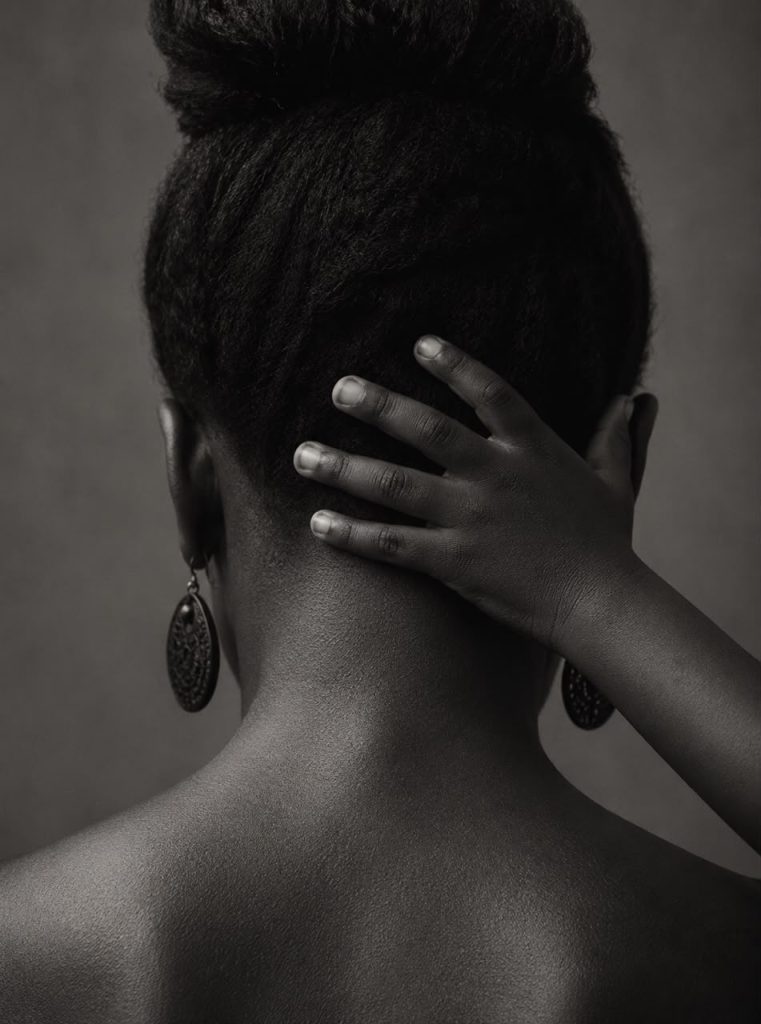
The photograph is built upon an extraordinary economy of gesture. The hand touching the back of the head is not dramatic enough to be read as grief, nor relaxed enough to suggest complete ease. It exists somewhere between memory and contemplation. That uncertainty is where the photograph gathers its emotional force. The body appears composed, yet there is an unmistakable suggestion that thought has become physical. The hand becomes an extension of memory itself, reaching instinctively toward the place where experience is carried but rarely seen.
Vivian’s decision to work in monochrome is fundamental to the success of the image. Black and white photography has often been associated with nostalgia, yet here it performs a different task. It removes the distractions of colour, allowing light to become the principal narrator. Soft illumination traces the curve of the shoulders and the elegant line of the neck, transforming skin into landscape. The photograph celebrates texture rather than ornament, reminding us that the body itself carries histories long before clothing or adornment begins to speak.
The exhibition title, Rhythms of Heritage, quietly unfolds within the composition. Heritage is not illustrated through familiar cultural objects or ceremonial costume. Instead, Ekpokpo locates it within posture, gesture and presence. The woman’s earrings offer the only visible ornament, yet even they resist becoming symbols in isolation. They remain secondary to the body’s silent language. The photograph proposes that inheritance is not always visible in what we wear but in how we inhabit ourselves. Culture survives in gestures repeated across generations, in habits learned without instruction, and in the quiet dignity of the body remembering what language cannot fully articulate.
There is remarkable restraint in the composition. The background withdraws into darkness without becoming theatrical, leaving the figure suspended in an undefined space. Nothing competes for attention. Every formal decision directs the eye toward the relationship between the hand and the body. The absence of visual distraction slows the act of looking, encouraging prolonged observation rather than immediate interpretation. Ekpokpo understands that stillness is not the absence of movement but the presence of concentrated meaning.
Perhaps the photograph’s greatest achievement lies in its refusal to resolve itself. The woman is neither hiding nor presenting herself. She occupies an in-between state where privacy becomes a form of strength rather than withdrawal. Contemporary portraiture often depends upon direct eye contact to establish emotional connection. Ekpokpo overturns this expectation completely. By turning the subject away from the viewer, she transforms observation into reflection. We are no longer looking at a person as much as we are confronting our own instinct to search for certainty in the visible.
In Rhythms of Heritage, Vivian Ekpokpo demonstrates that portraiture can be most revealing when it withholds its most familiar element. Through disciplined composition, subtle symbolism and emotional restraint, she constructs a photograph that speaks quietly yet lingers long after the encounter has ended. It is a work that understands heritage not as something displayed for admiration, but as something carried within the body patiently, invisibly and with enduring grace.