

By Josephine Agbonkhese
Here is something that should bother you more than it probably does.
The leather that goes into a Louis Vuitton bag, a Gucci wallet, a Ralph Lauren belt, a significant portion of it comes from Nigeria. Places like Kano, where hides have been processed for centuries using techniques refined across generations of craftspeople who understood leather at the level of the hands before they understood it at the level of the market. Processed Nigerian leather in Nigerian facilities by Nigerian workers are exported, semi-finished, to Italy, Spain and France, where it is completed, branded, and returned to the world as European luxury.
The Made in Nigeria label vanishes somewhere between Kano and Milan. What arrives on the shelves of Bond Street and Fifth Avenue carries a different address, and a price that reflects the value of that address rather than the value of the material or the knowledge that produced it.
This arrangement has persisted for decades and this is because it is commercially convenient for the European houses that benefit from it, and also because Nigerian leather producers have historically lacked the finishing infrastructure and the distribution networks to compete at the retail level, and because the global luxury market’s geography of legitimacy, its deeply held assumption that quality flows from certain places and not others, has made it easier to sell Nigerian leather as Italian leather than to sell it as what it actually is.
A generation of Nigerian designers has decided they are done with this arrangement, and now, through production and the sustained, meticulous, day-by-day work of building leather brands in Nigeria that are good enough to make the argument for themselves, without the borrowed authority of a European address, or the apology for where they come from.
What follows is ten of them. Not a comprehensive survey though, and not by ranking. This is a portrait of a movement at a specific and significant moment. A moment when it is no longer possible to look at what is being built in Lagos and Abuja and dismiss it as merely promising, interesting, or culturally significant but not quite luxury, because it is luxury.

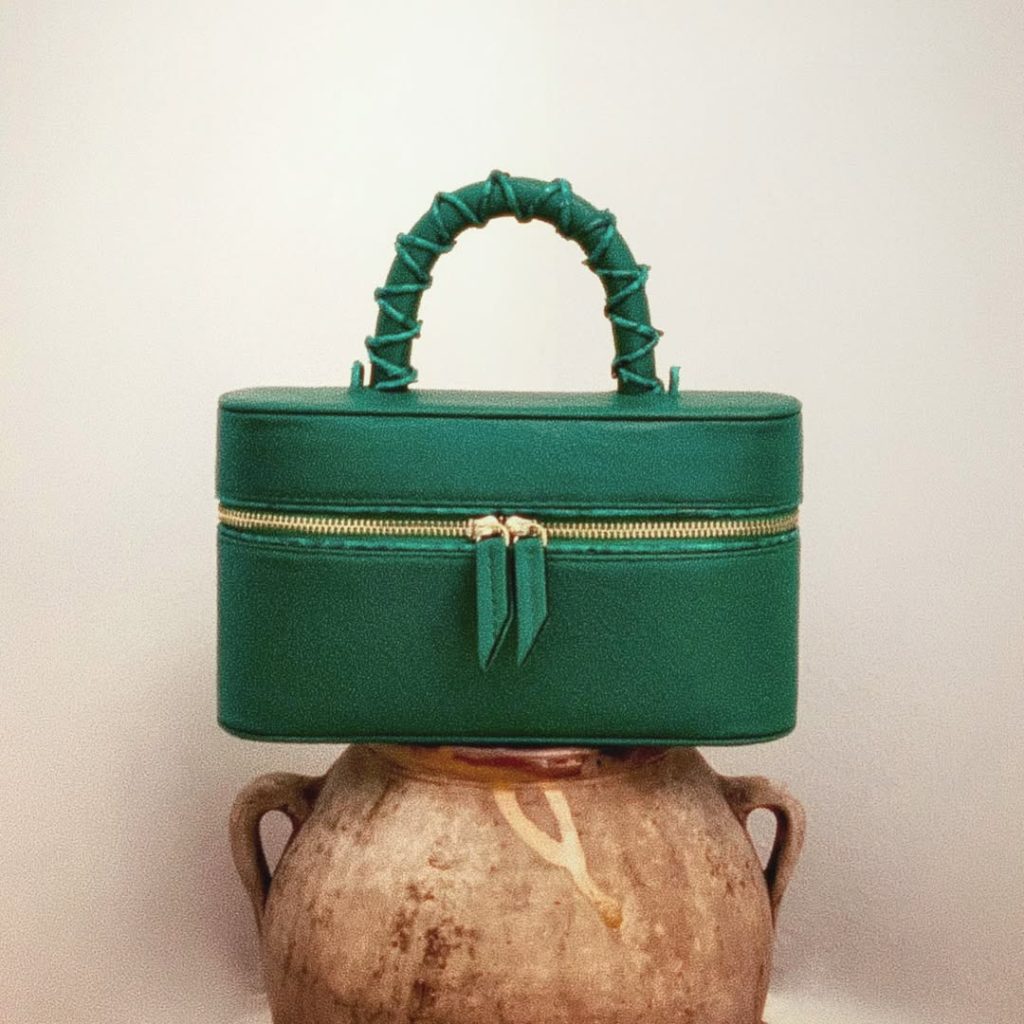
Zashadu
Zainab Ashadu did not set out to make a statement. She set out to make bags that were worth making, and in doing so, produced one of the most quietly authoritative design languages in contemporary Nigerian accessories.
The material choices are where Zashadu begins and where it is most distinctive. Locally sourced sustainable leathers, exotic skins, rough-cut precious stones set in brass. This is a material philosophy, and a considered position about where value comes from and how it should be expressed in a physical object. The stones are not polished into conformity with Western jewellery conventions. The brass settings are made here, by hands that understand the material. The leather carries the specific character of Nigerian sourcing, not despite its origin but because of it.
Ashadu like most serious luxury houses, understands that a design language is not a look, rather a set of convictions expressed through material decisions, repeated consistently enough that the convictions become legible in the object itself. When you pick up a Zashadu piece you will know, without being told, that someone made deliberate choices here. The choices accumulate into something that has no direct equivalent in the current market. That is what a genuine design language produces.
Zashadu has been in the industry for a couple years building her brand. The recognition has been steady and we can only expect more in few years to come.
FemiHandbags
The founder of FemiHandbag describes becoming an entrepreneur as an accident. Looking at what she has built, the accident seems to have known exactly where it was going.
FemiHandbags has done the things that the Nigerian accessories conversation talks about doing and rarely achieves: it has shown at Pure London, one of the UK’s most significant trade shows for fashion buyers and retailers. It has been featured on CNN Marketplace Africa as a business story, the kind of coverage that reaches the buyers and investors who move markets rather than audiences who simply follow trends. It has also been used as a case study for MBA students, perhaps the most unexpected and, in some ways, the most significant recognition of all. Because it suggests that the business model behind the bags is not just commercially successful, but instructive enough to be studied by the next generation of business leaders.
The evidence of her international exposure, and her significantly refined craft are themselves evident in the bags.
Winston Leather
Winston Udeagha was born into the Nigerian leather industry in the most literal sense. He is a descendant of a long line of leather suppliers from Kano, which means the material knowledge that most designers must acquire through years of study and experimentation, he absorbed through proximity before even he was old enough to understand it.
This inherited knowledge shows in Winston Leather in specific and important ways. The relationship the brand has with leather is markedly different from that of designers who simply learned to work with the material later in life. For Winston, leather has always been present. He understands its behaviour, its variations, and its specific responses to different finishing techniques at the level of the body rather than the intellect.
The resulting pieces have a quality of material confidence that is difficult to manufacture and impossible to fake. Surprisingly, the leather in a Winston piece is not chosen to look expensive, but chosen because Udeagha knows what good leather looks, feels, and behaves like, and will not use anything that falls short of that standard. This is the specific inheritance that Kano’s leather tradition represents, and Winston Leather is one of the clearest examples of what happens when that inheritance is brought into contact with contemporary design intelligence.
1403 Luxury
Most of the brands on this list are Lagos brands. 1403 Luxury is an Abuja brand, and the distinction matters more than geography.
Abuja’s luxury consumer is a different creature from Lagos’s. She tends to be older, more established, less interested in the signalling function of fashion and more interested in the quality and the discretion of what she owns. She has specific requirements and the purchasing power to insist on them being met. She is also, historically, underserved by the Nigerian accessories market, which has built most of its infrastructure around Lagos and has treated the capital’s consumer base as a secondary consideration.
1403 Luxury serves the Abuja consumer with the specificity she deserves. Bespoke shoes, bags, and accessories, crafted for people who have thought carefully about what they want and are prepared to wait for it to be made correctly. The bespoke model is not simply a commercial proposition, but an argument about luxury itself, that the most valuable thing a brand can offer is not a beautiful ready-made object but an object that is made for you specifically, that carries your requirements in its construction, and that belongs to you before it is finished.
O’Eclat
O’Eclat does not make noise. This is, in the current Lagos accessories landscape, an increasingly unusual and increasingly valuable quality.
The brand makes premium leather handbags and accessories with a focus on detail that reveals itself gradually instead of the shouty immediate announcement sort of. This is the specific aesthetic position of a brand that is designing for women who look carefully. The brand focuses on details that produce loyalty, details such as the specific way an edge has been finished, or the specific quality of the leather’s surface at the most-handled points, the precision of a seam etc. The understanding of the real value, that the person who made this was paying attention to things that most people would not have paid attention to arrives only through sustained use. The O’Eclat is building a reputation the slow way. Which is, in the long run, the only reliable way.
Marte Egele
Marte Egele starts from function and arrives at beauty, which is the opposite of the direction most fashion takes and the more honest of the two.
The design philosophy behind the brand is not decorative. It is ergonomic, an understanding that a bag is an object that is used rather than displayed, that it will be filled and carried and opened and closed and set down and picked up hundreds of times across its life, and that every element of its design should therefore be the result of thinking about use rather than thinking about appearance.
The Bui Satchel is the clearest expression of this philosophy. Accordion side detail that expands for capacity. Top flap magnetic closure. Inside pockets. A back pocket. Bottom metal studs that protect the base from the surfaces it is set on. A detachable leather shoulder strap. Each of these is a solution to a real problem that real women have with the bags they carry every day. Together they produce an object that is, in the most rigorous sense, well-designed instead of simply being well-made or well-styled, which means that the thinking behind it is as sophisticated as the making of it.
Beauty is present in Marte Egele’s work. But it arrives as a consequence of the thinking rather than as a substitute for it.

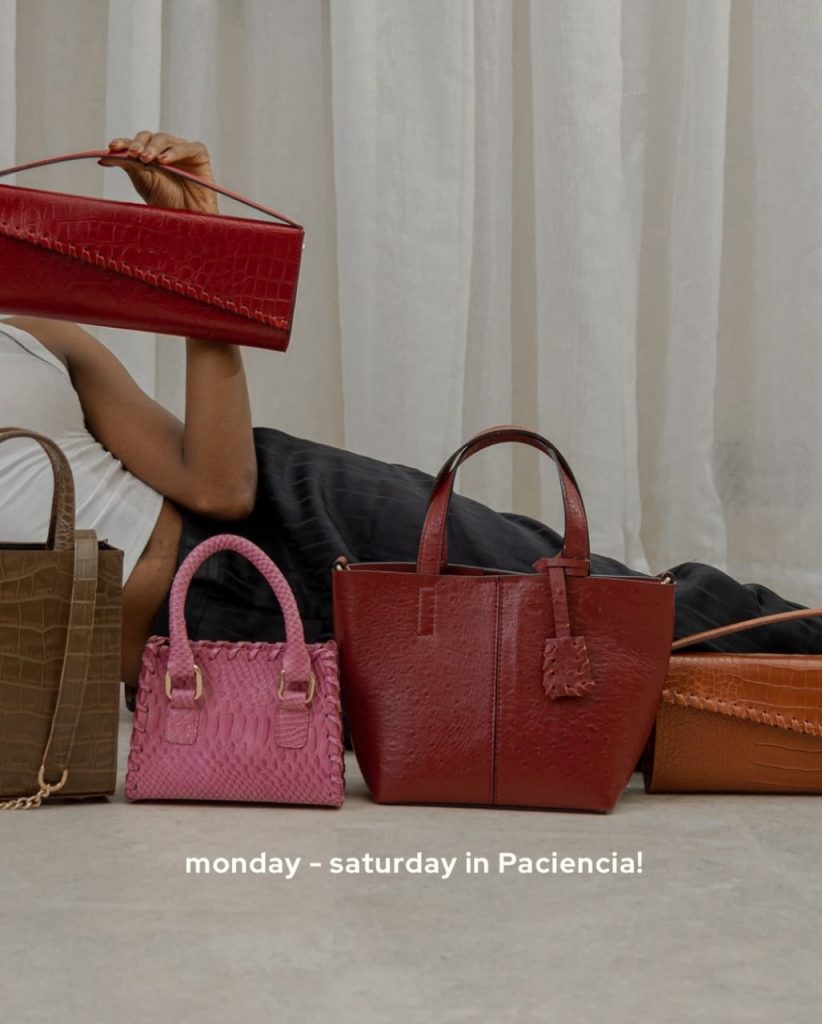
Paciencia
Joy Fache James named her brand, Paciencia, after the Portuguese word for patience in 2021 and the name has proven, across four years of building, to be less a brand identity and more a prophecy.
The bags are handcrafted in Lagos from real leather sourced in Nigeria. The signature across the collection is a handwoven leather detailing, strips of leather interlaced by hand, structural rather than decorative, giving each piece a surface that changes with the light and rewards the kind of close attention that manufactured objects do not invite. The silhouettes are minimalist and architectural. The interiors are leather-lined.
What distinguishes Paciencia within this list is not simply the quality of the individual pieces because several brands here produce individual pieces of comparable quality. It is the coherence of the project. The design language, the production philosophy, the commercial discipline, the international expansion, and the community initiative running alongside all of it. She Creates Fashion Initiative for instance established by Joy in January 2024 aims at training emerging female creatives in fashion, entrepreneurship, and sustainable design. Reviewing this thoroughly, all elements put together form a single legible argument about what a Nigerian luxury brand can be and do and mean.
The argument has been confirmed repeatedly and independently. The Emmy Kasbit runway at Lagos Fashion Week in 2023. London Fashion Week’s 40th anniversary edition in September 2024 through the Vanity Hub Africa platform. The Wema Bank MSME Grant at Lagos Leather Fair 2025, one of three from sixty-six competing brands. Most recently, the Jerry Eze Foundation Business Grant in April 2026, selected by KPMG from over sixteen thousand applicants.
Each of these confirmations arrived because of the same thing which is the work, apparently not the marketing nor even the positioning. The work, submitted to scrutiny, holding up under it.
Isi Omiyi
Isi Omiyi is fifty-six years old and she has been watching Nigerian leather disappear into European supply chains for most of her adult life. She is done watching.
In her Lagos apartment, she has created a boutique space where bags, wallets, and shoes are displayed on shelves, some carrying price tags of up to $1,500. The prices are not aspirational. They are truly accurate. That’s honest accounting of what it costs to make something well, from materials that are good, by hands that know what they are doing.
“Leather is part of our heritage,” she told AFP earlier this year. “I can’t just stand by and watch others receive all the credit for work that we started here.”
That sentence is the entire thesis of this article, stated in twenty words. Omiyi has been living it for years. The work she is making in that Lagos apartment is the work that should never have needed to leave Nigeria to be considered valuable. It is valuable here. It has always been valuable here, in fact. And, she is simply making that impossible to ignore.
Qreenade
Not every Nigerian leather brand is quiet. Qreenade is not quiet.
Where Zashadu is restrained and Paciencia is minimal and O’Eclat is considered, Qreenade is expressive, carrying what one observer described as Lagos energy in physical form; Vibrant, Fearless, Interested in presence rather than restraint, in being seen rather than in rewarding the patient observer.
Even so, this is not a lesser aesthetic position, rather a different one, and the Nigerian leather movement is richer for containing both. The assumption that luxury must whisper is a European assumption, rooted in the specific cultural context of the houses that have defined luxury for a century. Nigerian luxury does not have to inherit that assumption. It can choose its own register.
Qreenade chooses its register with confidence. The pieces are bold because the designer believes in boldness, not because she lacks the technical ability to produce restraint. There is a meaningful distinction between those two things and it shows in the work.
Aranat
Aranat closes this list because it represents something that all the other brands on it, at their best, are building toward: the specific authority of a designer who has taken enough time to fully understand what she is making before releasing it to the world.
The brand does not release often. The fashion market rewards constant content and continuous drops, so this restraint is either a liability or a statement of intent. From observable scores, Aranat’s case is the latter. The pieces that do emerge carry the precision of objects that have been considered from every angle, whose proportions are correct, material choices justified, and construction reflects a standard that was held throughout rather than achieved only on the surface.
The Lagos accessories conversation does not always have the patience for this kind of building. Aranat has the patience for it regardless.
That, in the end, what connects all ten brands is not really aesthetics or pricing or even the kind of customer they sell to. Their methods differ and so do their stories. What they share is a certain seriousness about the work itself.
Patience. The belief that if something is worth making, then it is worth making properly, at the pace the work demands, and in the place where the knowledge and the material already exist. Not as compromise, and not as consolation. It is the work, and the work, increasingly, is speaking for itself.