

I often remind myself that when reviewing fashion collections, a strong idea is only the starting point. The real question is how effectively that idea translates into clothing, and how these clothes are used as symbols of expression.
Now, if you’ve ever lived in a city like Lagos, then you can relate to Kadiju’s stylistic approach to fashion. The brand sees Lagos as a place of non-stop movement, agility, and boisterousness.
It is upon this discovery that the creation of the “008 Collection is created. Through this artistic display, Kadiju presents a body of artwork that captures the Lagos experience both geographically and emotionally. Hence, its idea to create memorable outfits is not enough to establish the brand identity in the hearts of the audience.
So, the question remains: How has Kadiju ensured that its creations are not just a representation of a brilliant idea or creativity?
To answer that question, I have curated three global standards that would critically examine every design, every piece, every intention, and every conclusion. These criteria are: design language evaluation, concept and inspiration analysis, and comparative industry insight.
With that structure in mind, I begin with the opening look, the pieces that introduce Kadiju’s journey from here to there.
Design Language Evaluation: This will evaluate the brand’s standard in crafting outfits that sit between what was, what is, and what is becoming. This means the outfit reflects the motion of past realities, the relevance of the moment, and the desire for what is suitable and timeless.
Now, to break this further in a simple sequence, “What was”.
The ankle length, ruffled tiered, sleeveless orange gown with spaghetti-like straps reminds me of a Bohemian Romanticism garment from the 1990s, often worn for formal occasions, dinner parties, or casual events. In this sense, Kadiju creates highly functional pieces that can be worn to events that appreciate the wearer’s presence.
Likewise, the over-cascading ruffles add dramatic volume and movement, giving the wearer enough flair, motion, and grace. Perhaps the only clause in this look is that it is event selective, which isn’t really a problem for the wearer, especially if she’s the kind of woman who only shows up in places that matter.
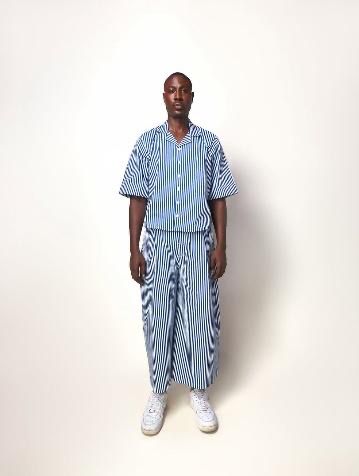
Another profound value of the brand is in its ability to design outfits that make the wearer not only confident, but relaxed and ready for any occasion. The collection features a blue and white striped short sleeved shirt and paired trousers. From the well placed buttons to a camp collar and a neatly sewn hem, I see a designer’s effort to create clean fits. Trust me, not all designers pay attention to finishing.
But as one who understands the stakes placed on creativity, this outfit clearly lacks that. Viewed from a distance, the monochrome, spiraling effect on the fabric print makes the piece appear like pyjamas, and in a way, reduces the intended value placed on the material. A gentleman who wants all the ladies’ eyes on him would rather go for a pair of wide-legged ripped jeans and clean white shirts, instead of these.
For the Picasso print long-sleeve t-shirt and high-waisted jeans, the brand employs yet another art expression that captures a distinct 90s vintage aesthetic.
This kind of outfit was widely worn in the contemporary mid-2020s as part of a modern resurgence in retro-inspired street style. In this light, the brand has carefully blended artistic expression with modern expectations, thereby reflecting art, comfort, and style. But what is comfort if it is not timeless? While I find the top a bit unsettling because of its length, I suggest that the brand reconsider pairing the top with a more modern trousers style, like a palazzo made from the same fabric or a complementary one, even. The jeans are a total fashion-fusion accident.
Now, what is?
What is a Lagos lifestyle without a Lagos night party life? As if crafted for younger women with eyes for trends and minimalist fashion, this one-sleeve black dress is a party stopper. But for a woman who honors modesty over trends, this design is not a suitable choice.
That is to say, the language communicated by the brand for this particular outfit is not universal. And in reality, the audience who might find this ensemble a little bit “offensive” is in the majority.
In the same light, the blue plunge bra top and handkerchief-hem midi silk skirt, like the one-sleeved mini black dress, is also geared towards a niche audience. Except that this outfit is solely created for outdoor events such as sports, the brand’s selective approach to style might risk losing some potential customers, and it is not a good fit for market relevance.
Also, beyond appearing like a modernized sports kit, this piece can also be styled as contemporary dancewear. So, ultimately, this is a spot on for the brand.
I think of class in the most minimalist way when I think about this keyhole mini red dress.
Composed of silk, such a piece is not just to decorate but also to accentuate the designers’ precision in cutting and finishing, reinforcing the brand’s meticulous approach to craftsmanship. But when I think of comfort and expression, I am restrained. Maybe a smaller keyhole at the breast region would have solved the issue of sheer dressing, a concern for maximalist fashion enthusiasts like me.

Then there’s the becoming phase.
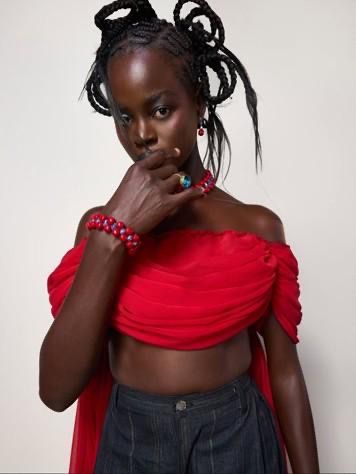
The last two pieces are quite contrasting yet aligning. The off-shoulder draped red top looks like a low budget Grammy Awards piece. It is as if the brand is making a promise to help upcoming celebrities feel important at high table events without necessarily breaking the bank.
And from where I stand, this attempt places the brand on a timeless fashion stage where overly dramatic outfits can appear simple. With this level of creativity, Kadiju seems to possess a kind of mastery that is not only expressive but also ageless.
Conversely, the sharp winged blue top and dual tone striped skirt embrace comfort, modesty, and motion. Unlike several designs in the collection, the brand breaks the jinx of minimalism and reveals clothing by prioritizing modesty in this piece. This look transforms simplicity into an everyday work of art. No drama. No exposure. Just classical and functional cuts.
Concept or Inspiration Analysis: This explores how Kadiju, through crafts and storytelling, expresses the boisterousness of Lagos life without losing its rhythm, motion, and, of course, clarity. It also mirrors the brand’s grounding principle in structure, silhouettes, femininity, and cultural expression.
The striking two-piece purple garment bears a striking resemblance to a saree set, which is often crafted with a heavy, patterned, and possibly made from silk.
And because of its density and weight, it doesn’t cling too loosely to the body, the way lighter silks do. Ultimately, the fabric choice strengthens the silhouette, giving the design an intentional, composed, and structured look, rather than the regular soft and fleeting. But this “heaviness” could also become a burden to the wearer.
This desert-influenced fashion style is rooted in heritage and practicality, capturing the brand’s theme in motion and movement. Additionally, the fabric tone is also perfect, automatically giving wearers “let’s go to the beach” or “brunch date” vibes.
I see Kadiju’s approach as a deliberate attempt to reemphasize desert clothing while still fitting into an urban African fashion context like Lagos. However, the look could have been more appreciated if it had been complemented by a blue, white, or even brown scarf, creating the picture-perfect desert look.
Next is the cream-coloured balloon-fit mini dress that translates the brand’s name “Kadiju”, meaning “let’s close our eyes”. On a deeper level, the puffball hemline tends to create a bold and fearless statement, a nod to the brand’s philosophy on “what is becoming”, an era when garments do more than just cover the body, but as a symbol of power, confidence, and presence.
While this philosophy appeals to women with Western fashion ideology, a typical African woman would call this a ballet costume and, as such, needs a pair of matching pop socks to give the look meaning. Perhaps Kadiju needs to review this gap if they want to remain relevant in the fashion scene.
For the last look, Kadiju seems to approach creativity from a linear and rhythmic approach, instead of volume. The stripes can be considered musical, each cream and black line a distinct beat. But while there’s a seemingly ongoing musical beat, the thin straps and simplicity of the top balance the tempo by focusing on the feminine frame. And because of this equilibrium, the outfit appears to be moving even when the wearer is standing still.
Comparative Insight / Industry Relevance: This criterion helps to recognize Kadiju’s relevance within its contemporaries and when placed on a global stage. To put it contextually, the brand shouldn’t just chase trends; rather, it must be intentional in moving its name a few steps further in the fashion world.
That said, the first look in this section features a sleek, column silhouette with a net-like, textured circular motif. Every structure is made with a strong emphasis on craft, from the straps to the bust and down to the ankle. Kadiju’s efforts to be intentional rather than trendy are quite commendable. I say this because I see how a few brands rely on just bold prints to signal “African fashion”. But in Kadiju’s case, the brand focuses on textural depth by using sophisticated black lace and possibly silk for the inner. This also positions the brand as a “potential” competitor with international fashion cities like France and Paris.
Placed side by side, a contemporary brand like VicNate, a Nigerian clothing label famous for its bold silhouettes, Kadiju’s sculpted bubble min dress, aside from playing by the rules of sculptural tailoring, also mirrors the loud and busy schedules of Lagos life. But beyond that is the brand’s avant-garde approach, storytelling through the use of traditional neckpieces. And even when compared to a global fashion home like Simone Rocha, this piece still breathes a clear cultural expression that is rooted in heritage and looks toward the future.
This piece is a black mini dress with enough space to carry a baby. The shoulders are high and supported by generous sleeves, creating a cocoon-like silhouette. Simone Rocha would call this kind of piece a modern romance, with a touch of historical drama.
And while the neck beads show respect to African heritage, the hat is a reminiscence of olden days England.
If the cocoon dress above has enough air to hide a child, then the knee length cobalt blue gown is a reinvention of the hot air balloon. It features a gigantic airbag blouse and a matching skirt. Clearly, this look can be compared to the works of Cristóbal Balenciaga. For a wearer who fancies hourglass and bodycon dresses like the works of Revolver’s bodycon, this airy silhouette would feel like a costume instead of a masterpiece.

After all, that is what Kadiju believe it has created.
In the end, has this review truly captured Kadiju’s philosophy? Perhaps yes, but in a few ways.
First, the brand has shown its commitment to structure, craftsmanship, and intentional design expressed through fabric choices, disciplined finishing, and baggy silhouettes. However, some areas that need refining have been pointed out.
For instance, some outfits show technicality, while others feel like an apprentice was basically experimenting. Nonetheless, given a five-year prediction about the brand, I see a fashion house exploring more sculptural, living, breathing pieces of art, and this cobalt dress is just an introduction to that era.
By Dimeji Alara