
TOKYO JAMES 2025 – IMPERFECTION
Looking good is a good business in the fashion world, but it must not look perfect. Life is not perfect, by the way. So why should clothes be perfect? Tokyo James decides to touch on the imperfections that are common in everyday experiences, bringing the human in all of us. This is something rare in the fashion world. For most people, imperfection is a flaw that should be hidden. However, Tokyo James has taken that part of us that makes us human and exposed the beauty through intentionality and creativity.
The fashion brand is driven by a clear mission to redefine what “looking good” means within Africa and on the global stage. Its design language draws from Savile Row-inspired tailoring while introducing unexpected colour choices, bold textiles, and a refined blend of African and European influences. Elements that may traditionally be viewed as irregular or unconventional in classic tailoring are deliberately reinterpreted as strengths, giving each piece a distinct and memorable identity. This approach is strongly reflected in the 2025 collection, “Imperfections,” where perceived flaws are transformed into a confident expression of creativity, individuality, and modern fashion excellence.
One can clearly see the message he intends to pass and the inspiration behind each piece in the collection. The central theme and inspiration behind the 2025 collection is to change the narrative of what it means to be imperfect. Who sets the standard? Who set the rules? One can only wonder, and if I am to be honest, I already feel charged and motivated to embrace all things considered imperfect by merely looking through each piece in the collection.
Looking at the first design, you will agree with me that this cloth refuses to agree with a normal standard of swimsuit under the sunlight. Tokyo James steps away from the firm and original standards that are needed by quality fashion. With the choice of a dark wool, decorated with a few white stones like a night sky dotted with stars, the brand had successfully caused everyone to notice and admire a work that feels too rugged. It offers a truth that fashion, like life, is flawed in itself.
Noticeably, the choice for a short bodysuit, which is a rare choice over the choice of a conventional high-flying evening gown, directly opposes the idea of perfection, abandoning the shadows of everyday kind of luxury in favour of something that is rawer.
However, instead of the sleeveless, feather arm that swings unsteadily as if to celebrate chaos, it should have been done better, or with a long arm, which would have given it a decent feel of dressing. The plain black body of the suit should have adopted a perfectly patterned, small, shiny clothing decoration layout instead of the unevenly shared wave of shiny light that presents the notion of unrefined stones or rough surfaces.
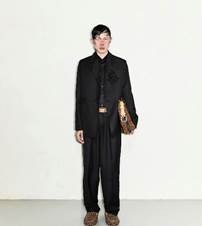
Here is another garment that offers a stark contrast to the one above, stepping away from the avant-garde clubwear to a style of clothing that covers the whole body in a way that seems willing to undermine the conventional classic tailoring.

This black suit looked beautiful, but a closer look shows a dress that avoids basic rules in how the lapel is done. The blazer, for instance, has a front wrap that is not finely done and also somewhat placed away from the centre.
The high chest pocket shows details of unique whitish polka dots. The shape and position are placed in a way different from what it’s supposed to, looking like a normal square pocket, but misrepresented in its form.
The style and the accessories around it show some kind of breakage in the flow. For example, the accessories add layers of texture in a way that is at odds with the black wool suit.
Now, the belt itself is placed the wrong way. The way the tan leather belt with a fine golden buckle is worn is noticeably away from the centre, strengthening the notion of a hurried dress-up, perhaps to show a state of imperfection. However, this also means disorder and lack of organisation whenever it appears that way.
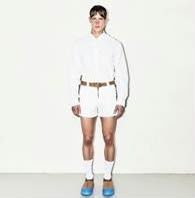
This one is a typical overthrow of a sunny day dressing suitable for the tropical climate of Africa. Yet, it injects a sense of plain vulnerability and tension in its design.
In normal attire, it is an acceptable practice to have an all-white outfit presented as a well-pressed, clean outfit. But Tokyo James chooses to introduce the opposite by using a material that is too rough for both the long-sleeve shirt and shorts. This kind of cloth imitates rumpled paper that reminds one of the imperfect natures of everyday clothes.
The combination of the button is too close, and the long-sleeve shirt, which is complemented by shorts that are sewn to be exceptionally short, reveals a shape that is fuller on the top side.
Again, just like the look above this, the tan leather belt is pulled to the right, making the waistband of the shorts gather too much. It should have pulled a little lower instead of resting higher on the hip in a way that suggests a rushed way of dressing for an outdoor activity.
With the wrinkles of the cloth, there is evidence of the promotion of imperfection, where perfection appears to be a lie.
Here is another design that shows how menswear can be combined with a firm design that breaks into grids. It is a long leather coat without a collar that appears as an observation in visual breakages. This coat is different from the clean, black leather chest into a checkerboard style with brown and black colours.
The lower half of the coat, which has a checkerboard pattern, chiefly looks like woven leather. Tokyo James accepts that normal dressing can use grids in their layers instead of matching a simple style with solid elements. Under the long coat is a pair of dark denim trousers, covered in a brown-yellowish, hand-drawn grid pattern.
Tokyo James combines a coat with the pattern of a checkerboard and a loose grid on the trousers. And the result creates a disorder in the brain. It turns the idea of clean, uniform matching of a high-end styling into a weak, off-the-vogue fashion.
Maybe, instead of introducing elements of incomplete and rough feeling, the coat could have retained a simple black covering outfit that covers the chest in a nice way for outdoor events.
If you want to think of a typical workwear through the lens of too much leather and styling anomalies, then this style here is a classic example.
Tokyo James uses a jacket and trousers to copy the usual jean dress that truck drivers are seen wearing. It successfully changes industrial workwear into luxury streetwear by changing the standard jean canvas to a deep espresso brown.
The way it is sewn shows every detail, including the seam, pocket flap, and panel line. Without hiding the technicality of the clothing, the needle line is introduced as a visual map of the garment’s tailoring to emphasise an industrial beauty. The sewing shows every detail, including the seam, pocket, and panel line.
The leather belt on this one is too long that it has to be hooked through the loops, but twisted and knotted around itself, without paying attention to the usually clean style of buckling. Perhaps, as the belt is too long, and its tails hang down, it should have been replaced with a more fitting size to avoid it causing the thick leather of the trousers to gather up around the waist, looking ugly. This makes the outfit look hurried and rushed.
This particular collection has a natural feel attached to it. It represents an exposition of the behind, which is part of what normal clothing seeks to protect. It has a look that completely removes the cover and structural layer of luxury wear, dragging the garment to a contemptible sight.
With the hemline at the back showing what simple clothes should hide, Tokyo James seems to replace the notion of modesty with the human body as its design style.
The frontal half of the garment hangs due to a lack of balance. It features a rough piece of white cloth that falls down the side, dragging towards the floor like a piece of material that has come untouched from the main design.
This piece acts as a visual provocation that breaks up the uniformity of the body.
For the sake of and in the interest of the societal quest for decency, The designer should have ensured that the hemline does not come up short of the measurement. The design is not a result of no available material, which makes the disregard for buttocks weird.
What the designer has done with this collection not only questions beauty standards but is equally refreshing, especially in the marketplace, which inevitably places a huge relevance to the collection.
The designer is offering the industry something new and different from what we see every day. Now, the world wants to see more of Tokyo James. The brand has gained the attention of the marketplace, and I wouldn’t be surprised if they announce that the collection sales were a massive success and sold out.
With designs like these, it isn’t a far-fetched thought to say he is well on his way to sharing the spotlight with brands such as Christian Dior or Chanel. I mean, the pieces have gotten the attention of Vogue! the brand has gained market relevance and is also playing in the league of industry big boys, these are enough clues to show that Tokyo James is making the African race extremely proud.
In conclusion, these collections, however, succeeded in achieving their profound theme on imperfection, a perfect statement on weakness. It makes bold to prove that uniform perfection is impossible. Every single choice is a concerted effort at proving that, away from traditional societal expectations, beauty and acceptance are a product of imperfection that makes reality truer.
By Dimeji Alara