THE FOOTPRINTS OF NAIJA: CUTESAINT’S SS23 COLLECTION
African piece at its best!…
This is what I would like to call Cute Saint’s Omo Eko’s SS23 collection.
In 2022, Cute saint fashion house showcased its SS23 collection at Lagos Fashion Week, presenting a body of work that celebrated beauty, cultural identity and authentic creative expression. The collection demonstrated how fashion can go beyond fabric, stitching and design technique, serving instead as a powerful visual language through which people communicate heritage, individuality and belonging without needing to say a word.
This creative vision was put into practise at the runway, let’s see…
Cute Saint opens the runway with a very striking Coral-pink and burnt orange swimsuit. It features a deep U-neckline that flaunts the wearer’s collarbone and chest. This piece looks sculpted because it hugs the body contours, giving the silhouette an intriguing look.
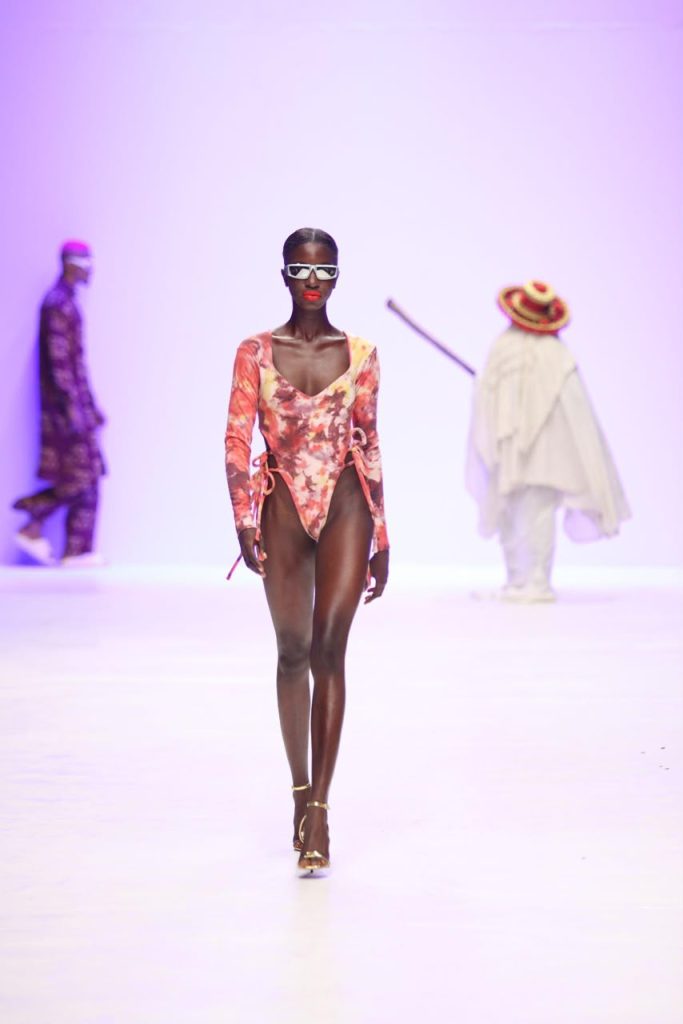
In contrast to the skimpy lower half, the swimsuit features full-length, fitted long sleeves. This creates a balance between the total coverage on the arm and high exposure on the legs.
Another striking feature of this swimsuit is the high-cut pelvic openings that extend well above the hip bone. This feature is most definitely inspired by high-leg swimwear looks, like in the 1980s.
In addition to this classic, the garment is adorned with functional or aesthetic drawstrings on both hip flanks that allow the fabric to gather, while adding more movement to the piece.
Its prints are no ordinary colours; they are patterned tie-dye, which makes this piece even more fascinating. Pieces like this are suitable for the beach parties, vacations and home relaxations.
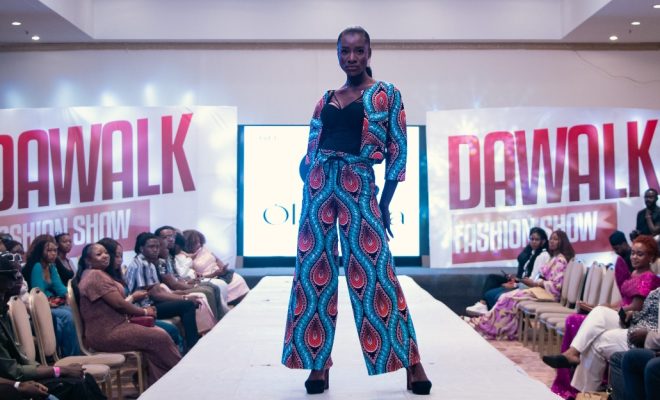
The second look in this collection comes in different styles. The first style I will be looking at is the burgundy two-piece. The outfit features an oversized and elongated button-down tunic shirt and matching wide-leg trousers.
It has a highly relaxed and slouchy silhouette. It also features a standard pointed collar, but it is styled partly unbuttoned.
Another, or the most fascinating feature of this piece, is its print. The garment is covered in a repeating stamped text print that reads ‘Omo Eko’- a Yoruba phrase translating to ‘Child of Lagos’ or ‘Lagos Native’ – a very distinctive way of portraying identity.
However, with all of these magnificent features, there are still some areas of improvement. The wide-leg trousers, for instant puddles heavily at the bottom. When it is paired with flat slides, it can look a bit too much like loungewear or pyjamas on the move.
To make this better, I suggest that the designer implement an internal cord, or hidden button, at the inner ankle hem. This gives the wearer the option to transition the pants from a pooling wide-leg to a gathered, voluminous jogger.
The second style in this section is an oversized indigo blue fluidly hanging day dress. It matches the tone of the previous piece, and it features a high band collar and balloon sleeves. These sleeves start wide at the shoulder, drop down to the arm, and gather at the wrist with an elastic, tight cuff.
The shape of this dress completely bypasses the natural contours of the waist and hips. It gives enough room for movement, and it’s breathable enough as the wearer walks rather than standing out stiffly like a tent.
The length of the dress is also very modest. It has an extra attachment at the back of the dress that gives it a little drama and class.
However, the printed fabric was overused in this outfit. And because there are no supporting elements like a waist belt or fancy string to pull in the waist, the garment tends to swallow the wearer.
Recommendation:
The designer should introduce an internal button or drawstring on the inside of the outfit, most especially around the waist. This enables the wearer to pull back some parts of the fabric, creating a snatched silhouette around the waist, and enhancing the overall look of the outfit.
Alternatively, a white or gold belt could also do the magic, rather than leaving it to hang loose.
The designer should also consider breaking the direction of the prints. As I said earlier, the entire fabric is printed, and this may cause the eyes to feel dizzy looking at it. To create that stability and, of course, maintain its ‘chicness’, the designer should introduce another fabric, this time in plain white. So, instead of an entire garment in prints, the sleeves are in prints while the body of the dress is made of white fabric.
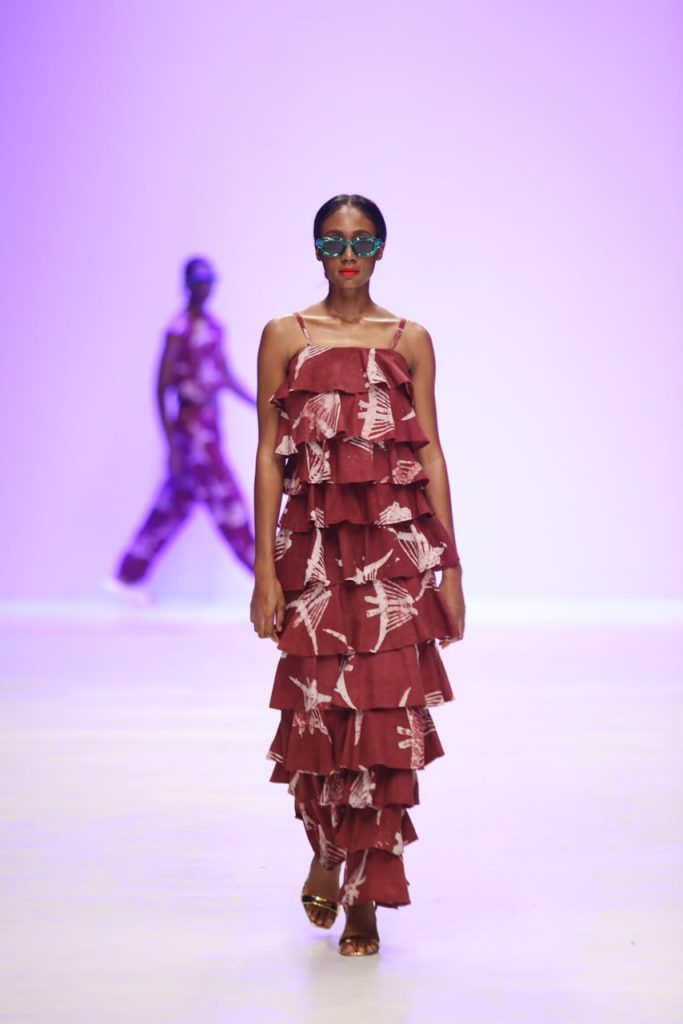
The third look in Omo Eko’s SS23 collection also comes in twos. The first outfit is a long brick-red dress. It has a spaghetti strap for enchantment and ruffles for excitement.
The dress is casual and incredibly loose for comfort. It hides the waist and legs because of its flexible silhouette. The ruffles are a delight here. They shake beautifully while walking, and they are most definitely the focal point of the dress.
Next to the ruffles, another compelling feature of this dress is its print. The brick-red dress has a repeating print that looks like the drawing of a bridge, specifically, the famous Third Mainland Bridge in Lagos, Nigeria.
And although all of these create a standstill on the runway, some of these features may seem a little overwhelming to some wearers.
The ruffles, for example, can look a little ‘too much’ for a wearer who prefers to be on the minimal end. Women of shorter frame may also quickly lose interest in this outfit, because it may come off too heavy for them.
However, to enhance the beauty of this dress and to make it serve more than just one physique, body frame or structure, the designer should consider making the dress in more than one design, with fewer ruffles on the chest.
The second style in this section is a two-piece design with the features of a sleeveless short shirt ending just above the waistline. It has a high, flat neck.
The sides of the shirt are completely open or tied loosely, exposing the arms. As for the pants, it comes in a loose-fitting style, just like cargo pants. They sit high on the waist and have big pockets sewn onto the sides of the thighs.
This outfit is noticeably what I would call ‘Swaggish’; however, the shirt still looks very flat and boxy, and the pants are very blocky.
A slight adjustment around the ankle could give the pants a more fitting look and enhance flexibility. Also, the shirt should be slightly longer in the front with a curved hemline. This would stretch out the look and make the top flow better into the high-waisted pants.
With the entire runway flaring up in high creativity, there is no doubt that Omo Eko’s SS23 collection is highly inspired by Africa’s heritage, most especially the beautiful city of Eko–Lagos.
From the tie-dye that signifies the Yoruba’s famous fashion ornament, Adire, to the unique prints used to identify the strength of Lagos, ‘Omo Eko’ and Third Main Bridge, Cute Saint moves closer to home and draws his audience back into the safe space of their native land, reminding them to own their identity and pride.
In comparison with some Nigerian designers, Cute Saint matches the same energy as designers like NKWO and Orange Culture. These designers are widely known for their artistic silhouette and key attention to detail.
NKWO, for instance, is known to focus on raw, eco-friendly textures and shredded fabrics, while Orange Culture majors in bright colours, soft fabrics and relaxed silhouettes, all of which make them fashion geniuses.
Still, there’s something about Cute Saint’s design. Although they are artsy just like NKWO and Orange Culture, Cute Saint’s designs are a living billboard for Lagos youth culture.
This fashion brand doesn’t just make abstract patterns; it prints literal bold statements and uses distinct local symbols that indigenes of a nation can resonate with, and that is true art.
Cute Saint’s Omo Eko SS23 collection shows us that fashion, even with all of the cargo pockets, balloon sleeves, and laced-up trousers, can still breathe origin and authenticity.
It demonstrates a very strong commercial capacity, caters to young urban consumers, fashion creatives, tourists, and members of the African diaspora who very much love clothing that reflects both contemporary style and cultural identity.
The collection arrives at a time when consumers are increasingly drawn to fashion that tells authentic stories. This is good because across the international market, there is a growing appreciation for culturally rooted designs, particularly those that celebrate heritage through modern silhouette.
The Omo Eko collection showed the heart of Naija and proved that fashion is not stagnant but ever evolving, and only designers who truly go beyond the natural aesthetics of shimmers and boards will become powerful themselves.