
Threads of Legacy: Koil Creations and the Art of Endurance
In an extraordinary act of discipline and artistry, Oluwaseun Lawrence Kuforiji, Creative Director of Koil Creations, created twenty-two garments over a span of 106 hours, 55 minutes, and 20 seconds.
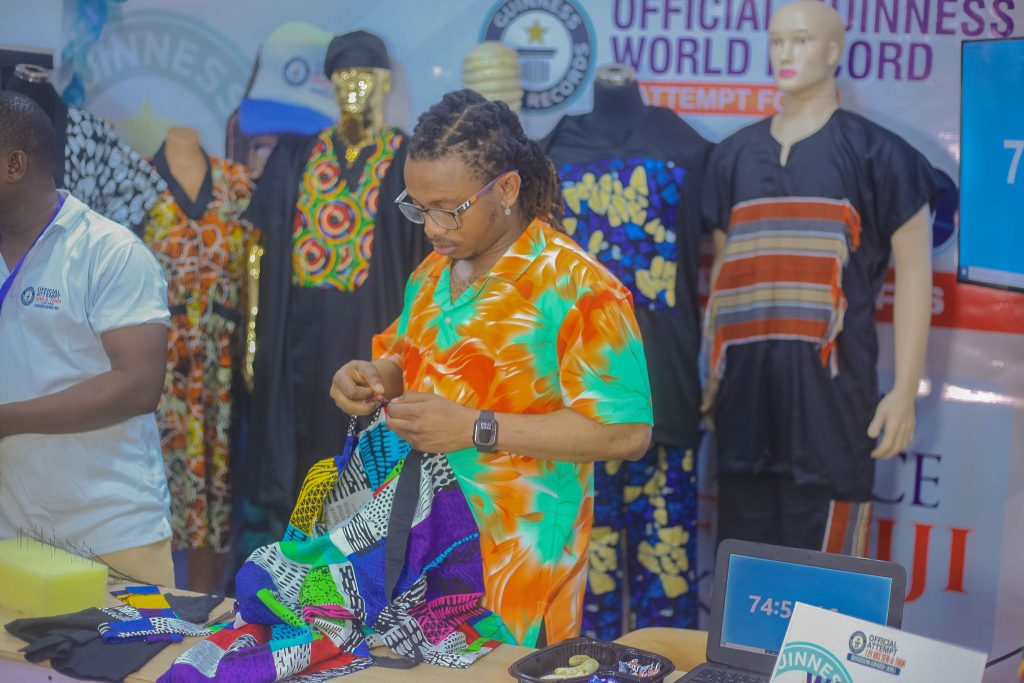
While the feat was recognized by Guinness World Records, the real story lies not in the stopwatch but in the work itself: a collection that bridges Yoruba tradition, contemporary fashion, and the endurance of handcraft.
What makes this body of work remarkable is not only the number of pieces produced but the method, every item was made with hand needles and thread alone.
In a world where fashion is increasingly defined by speed, machinery, and digital design, Kuforiji returned to the most elemental form of garment-making. The result was both technically accomplished and deeply symbolic: a reminder that fashion is first and foremost an act of human skill, patience, and resilience.

The twenty-two pieces reflect breadth as well as depth. From the grandeur of the Agbada and Danshiki, to the elegance of the Bubu gown, and the everyday dignity of Buba and Sokoto, Kuforiji’s output captures the versatility of Yoruba dress.
Accessories such as the traditional cap and muffler complete the collection, underscoring an understanding of not just clothing but of cultural ensemble.
The finishing is strikingly precise for garments made under such demanding circumstances. Stitches hold with clarity, embroidery appears intentional rather than hurried, and the silhouettes retain their intended form. This balance between speed and craftsmanship speaks to Kuforiji’s years of training and his instinctive control over fabric and thread.
The cultural significance of the collection has already been recognized. A selection of these garments now resides at the Egba Museum in Ake Palace, Abeokuta, positioning them not simply as fashion items but as artifacts of cultural history. Their placement in a museum space elevates them from clothing to testimony: evidence of what can be achieved when heritage, skill, and perseverance intersect.

If there is a critique to be made, it lies in the inherent limits of hand-stitching under time pressure. Some garments lean towards classical forms rather than pushing avant-garde experimentation. Yet within these boundaries lies the power of the project: it is not fashion designed for spectacle alone but fashion grounded in continuity, identity, and survival.
Kuforiji’s marathon of creation is, at its core, a manifesto. It insists that fashion is not only about trends or commerce but also about cultural preservation, endurance, and artistry. By choosing the needle and thread over the machine, he stripped fashion back to its essence and, in doing so, stitched a story that belongs as much to history as it does to style.