FASHION REVIEW: QUIET LUXURY GETS LOUDER
By Yemisi Suleiman
SedCaz isn’t your typical new-wave fashion label riding a viral moment. It’s the product of grit, time, and tireless refinement.
Long before the name change early this year, before the runway lights at Lagos Fashion Festival or the bold showings at Afrocentric Fashion Week, the designer, Ajayi Tolulope Sedomo, was already sewing for choirs, styling musical artists, and costuming local theatre performers. Backstage or behind the scenes, her eye for detail, balance, and story was taking shape—well before anyone was calling it a fashion house.
The journey to SedCaz began over a decade ago in university drama halls and church groups, where the founder was building costumes, making props, and experimenting with silhouettes. No formal fashion school. No shiny shortcut. There was just a curiosity and an unshakable need to create, which over the years translated into hard-earned skills like pattern-making, sketching, construction, textile dyeing—all learned through self-study, online resources, apprenticeships, and lived experience.
That’s the soul of SedCaz today: a brand born from discipline, not just dreams.
But don’t mistake that backstory for modesty. SedCaz has grown into a multidimensional design house with a far-reaching portfolio. It has created bridalwear for private clients, tailored suits for clergy, and blazers for schools. It has dressed the Catholic Bishop of Oyo since 2019 and continues to serve as the official seamstress for the Dominican Order of Preachers in Ibadan. More than 50 apprentices have trained under the label, and the brand has actively collaborated with other Nigerian fashion houses—proof that SedCAz doesn’t just grow, it multiplies.
Its designs follow suit: thoughtful, intentional, and often infused with Afrocentric elegance. The clothes feel like they’ve been lived in, carrying both memory and innovation. One look might feature tulle, lace, and romantic drapery; another, a crisp Ankara two-piece with streetwear ease. SedCaz work sits at the intersection of the personal and the polished. It tells the kind of story that can only come from someone who’s done it all—from hemming cassocks to styling comedians to teaching textile dyeing to undergrads.
So, no—it’s not trying to be disruptive for the sake of the runway. What SedCaz offers is more deliberate and rooted in an identity that doesn’t need spectacle to feel important. With international expansion now on the horizon and a fresh collection expected later this year, it’s clear this brand is evolving without losing its core.
In this review, we examine three selected outfits from SedCaz latest line. We’re asking: how well do they reflect the brand’s stated philosophy? Where do they shine, and where might they stretch further? And above all, what do they reveal about the woman and the legacy behind the seams?
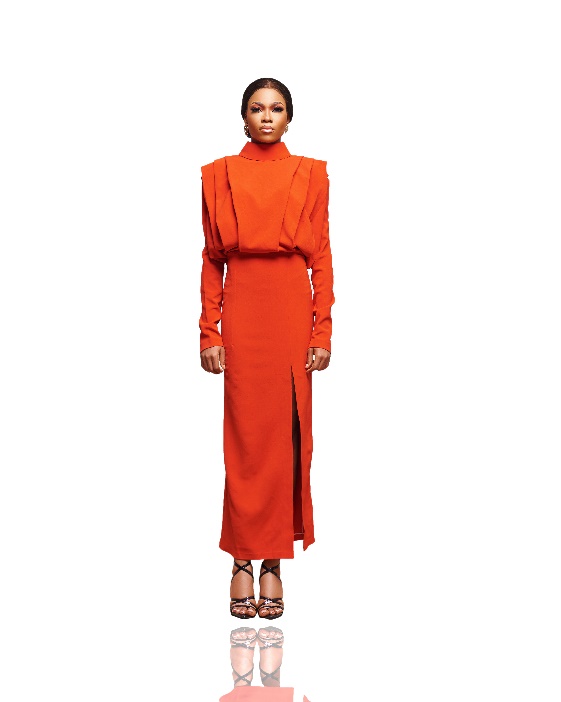
The first look initially appears to be a simple monochromatic statement, quickly reveals itself as a sculptural meditation on power, silhouette, and identity. The look favours deliberate design choices that honour both Afrocentric traditions and the brand’s pivot toward minimalist luxury while avoiding excess ornamentation.
The fabric, a rich, matte orange, is not merely a colour choice but a cultural signifier. It gestures toward traditional Nigerian palettes without the literalism of print, allowing hue alone to evoke warmth, energy, and ancestral memory.
This is consistent with SedCaz post-bridal direction of stripping back decorative layers to expose the bones of intention, and letting form do the storytelling.
At the centre of this look is a sharply tailored bodice that is crafted from generous folds and angular pleats that rise into a dramatic armour-like shoulder structure. It is bold without being aggressive, soft without surrendering strength. The vertical and diagonal lines formed by these pleats bring back the draping traditions of ceremonial agbadas and the spiritual presence of African matriarchs, figures who carry both literal and figurative weight on their shoulders.
This construction, quite unlike the delicate intricacy often found in the brand’s bridal roots, is assertive, suggesting a woman who enters rooms to be remembered.
The high neckline and long sleeves are a study in control and coverage. They wrap the wearer in a modest frame that doesn’t hide the body so much as dignify it. The restraint is intentional—typical of SedCaz Afro-minimalist approach—but the look avoids rigidity through a series of subversions. Chief among them is the deep back slit: a surprising, sensual rupture that disrupts the garment’s otherwise monastic calm. Secured with two clean, deliberate buttons, it’s a subtle provocation—inviting the gaze, but on the wearer’s terms.
Below, the full-length skirt part of the gown falls with an unbroken vertical grace, save for a centre slit that grants movement and just a hint of leg. The lines are clean but never lifeless. Instead, they act as an anchor to the sculptural drama of the upper half. One might wish for a touch more textural contrast or a slight shift in silhouette—perhaps a gentle flare or layered hem—to echo the dynamic tension above. As it stands, the skirt is beautifully restrained, though perhaps almost too quiet for the thunder of the bodice.
Accessories are kept wisely minimal. The model’s slicked-back hair and strappy black heels offer no distraction from the garment’s architectural story. In future iterations, one could imagine this look reinterpreted with stacked coral beads or leather cuffs—accents that would localise and ground the look more directly in Nigerian artisanal vocabularies.
Yet even without them, the look holds its ground. It tells the story of a woman who is elemental, not ornamental—someone whose presence is defined not by sparkle or sway, but by structure and intentional grace.
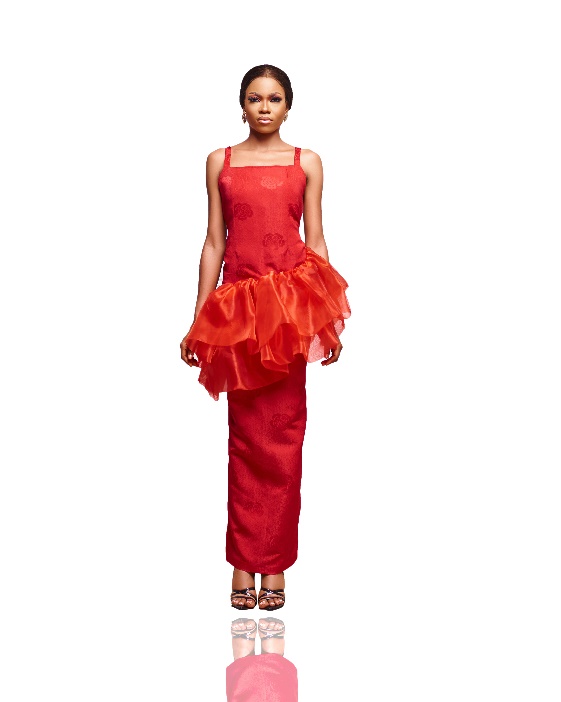
The next look opens with a square neckline and slim straps that rest neatly on the shoulders while giving the upper half a sense of restraint. It’s a strong minimalist setup that might have been elevated with a more intentional strap design—perhaps a wider band or one that echoes the organza’s texture. As it stands, the bodice feels somewhat disconnected from the rest of the garment, like a whisper before a scream.
Then there’s the ruffle. Full, unapologetic, and alive with movement, it bursts out from the hips in a fiery contrast of orange organza layered atop itself. This is the visual climax of the look—playful yet sculptural, celebratory yet precise. The asymmetry keeps it from feeling too girlish or predictable. But while the intention is clear, the finishing falls a bit short. The way the organza is gathered lacks subtlety in certain areas, creating bulk rather than fluid volume. A softer hand in construction, maybe through tighter ruching or shaped panels rather than circular gathering, would have allowed the fabric to breathe without swallowing the hips entirely.
Beneath all that volume, the skirt bit falls back into composure. It’s cut in a slim, straight silhouette that elongates the frame and gives the outfit its mature edge. The use of what appears to be a red floral brocade or damask anchors the look in cultural familiarity while still feeling fresh. Yet in motion—or even in stills the fabric reads a bit stiff, creating slight tension between its visual richness and physical restraint. A silk-infused damask or a lined satin weave could have preserved the pattern while offering a bit more flow and comfort.
From behind, the outfit simplifies—almost too much. The back view reveals clean darts, a modest slit, and the continuation of the organza ruffle. While elegant, it misses the opportunity to surprise. A deeper scoop at the back, a tie detail, or even an off-centre slit might have helped carry the garment’s forward-facing energy all the way around. As it stands, the drama fades too early.
Overall, this look offers the kind of duality that SedCaz is beginning to master: a mix of control and chaos, ease and excess. It captures the visual language of a high-end owambe guest, present, poised, and ready to make a statement. With more polish in the finishing and a few thoughtful tweaks in the construction, this dress could move from strong to unforgettable.
There’s a certain kind of outfit that walks into the room before you do — SedCaz bold orange two-piece ensemble is one of them. The bold orange colour is the first thing that catches your eye. It is a warm, rich tone that boldly rests on the skin and doesn’t want to blend into the background. It is a colour choice that feels intentional, an act of fashion rebellion in a world often obsessed with safe and muted palettes.
The sharply constructed shoulders evoke the elegance of 80s couture with a contemporary touch. There is a quiet confidence in how those shoulders frame the wearer’s stance, creating a commanding presence without the need for embellishment or noise. It’s a lesson in restraint — allowing cut and colour to speak.
However, even statements benefit from subtle adjustments. While the fabric does well to hold shape, there’s room for refinement in its texture and finish. There’s a visible tension in places along the button placket and side seams. There is also a slight puckering that disrupts the otherwise clean lines. A higher-weight crepe or a softly structured satin-backed fabric might offer both the strength and fluidity this silhouette demands while adding a whisper of luxury to the already bold narrative.
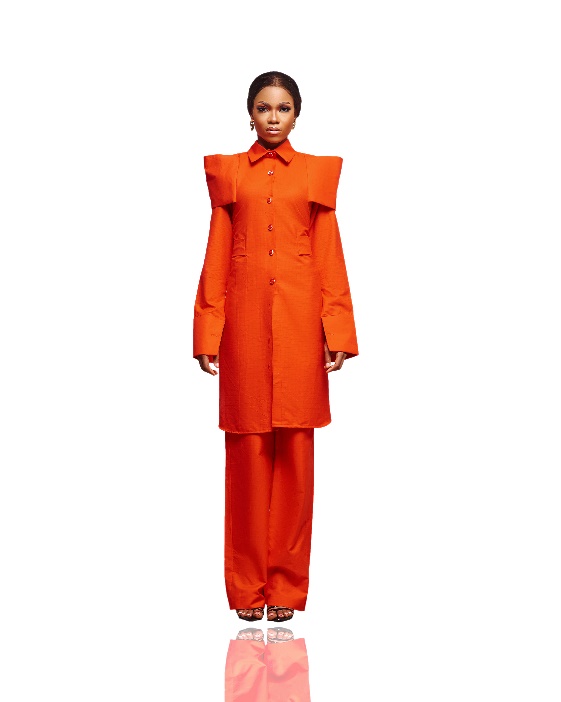
The sleeve length is made deliberately dramatic and risks tipping from avant-garde into impracticality. A touch shorter or designed with a pronounced flare or slit would grant both ease and elegance, ensuring the sleeves remain a feature without overpowering the garment’s balance.
One cannot overlook the opportunity that lies in the button detailing. Here, the choice to colour-match is safe — perhaps too safe for a look this brave. Introducing contrast buttons, maybe in a muted gold or textured wood, would introduce a secondary focal point, lending depth and a whisper of understated luxury to the ensemble.
The back detail is a thoughtful touch. The soft bow cinching the waist brings a welcome note of femininity that subtly tempers the boldness of the shoulders and creates a harmonious silhouette from every angle. It is these intentional contradictions that define SedCaz emerging voice in Nigeria’s fashion scene.
In its entirety, this look feels like a brand in confident evolution. It’s the kind of ensemble destined for editorials, for modern bridesmaids seeking an alternative to gowns, or for a style-conscious guest at a high-profile event. SedCaz is onto something here, and with minor refinements in fabric handling and detailing choices, this power set could easily become one of the house’s defining looks.
In the end, what stands out brightest is SedCaz feel for balance between hardness and softness, tradition and modernity. These designs are seeking presence, not perfection, and they leave an impression that endures longer than trends could ever hope to.